Monday, September 5, 2011

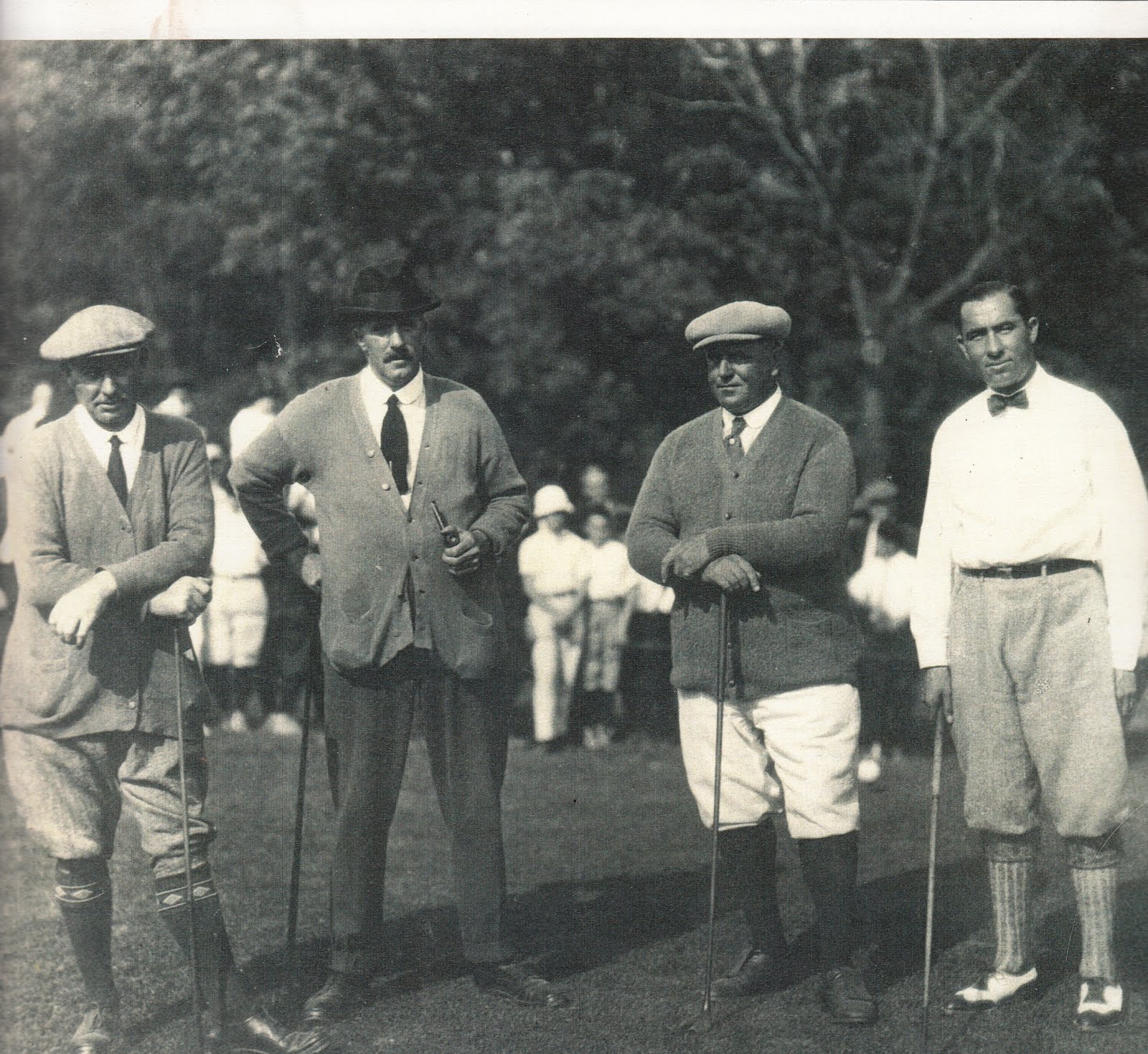
The Ultimate Foursome - Vardon, Ray, Fraser and Hagen


In the fall of 1921 Harry Vardon and Ted Ray played an exhibition match against James Fraser and Walter Hagen at Pottstown, Pennsylvania.

Fraser, from Fraserburg, Scotland, was the Seaview Country Club (NJ) professional, whose ten year old son Leo would caddie for him that day. Leo would go on to become the Seaview pro, the owner of the Atlantic City Country Club and an important PGA administrator.

Harry Vardon and Ray Ted, both from the English channel Island of Jersey, were among the first UK professionals to take golf on the road and physically promote the game.

Walter Hagen, the obstinate Yank, would become known as the "great emancipator" for giving the golf professional the status of gentlemen and thus permitted in the club house, from where they were previously regarded as employees. Hagen was the first touring golfer to earn a million dollars.

Vardon, Ray and Hagen won 16 US and British Opens among them.

Ted Ray won the 1912 US Open and 1920 British Open, while Harry Vardon, said to be the greatest ever, won the 1900 US Open and the 1896,1898,1899, 1903, 1911 and 1914 British Opens. Walter Hagen, who would be the first successful touring pro, won the 1914 and 1919 US Opens and 1922, 1924, 1925, 1926 and 1927 British Opens.

James "Jolly Jim" Fraser had played in some early Open tournaments and while primarily a club professional, he was no slough, as Fraser and Hagen won the match with Vardon and Ray, said to be one of only two exhibitions they lost on that tour.

Vardon made three tours of America, playing an exhibition at the Atlantic City Country Club in 1900, and in 1913 was accompanied by Ray and Wilfrid Reid. All three played in the famous Shawnee Tournament and "The Greatest Game" at the U.S. Open at Brookline. Two years later Wilfrid Reid would assume Fraser's job as pro at Seaview when Fraser would be killed in a traffic accident. Reid would also lay out the original Lakeside course at the Olympia Club in San Francisco where the 2012 US Open will played.

The 1921 tournament at Pottstown was played over a course that was part of Hill School, but a few years before this match was played the Brookside Golf Club was formed by the citiens of Pottstown and today it remains a very respectable club rich, with history.


Sunday, September 4, 2011

Old Sandbox at the First Tee - ACCC


Sand box at the old first tee at the Atlantic City Country Club

Before a black New Jersey dentist invented the wood golf tee, golf balls were placed on small pinches of sand before they were driven with the first shot.

1911-12 US Open Champion John McDermott continued to use pinches of sand even after the golf tee became popular.

The modern tee

An early tee designer who gets a lot of attention today in websites and the popular press is Dr. George Grant, the first black graduate of Harvard's dental school. His version of the tee, patented in 1899, consisted of a vertical rubber tube attached at its base to a carrot-shaped piece of wood. It was not the first-ever golf tee as is often claimed, and in fact did not differ much from the earlier pegs that similarly combined a flexible ball rest and a rigid ground anchor.

Since Grant did not sell or promote his handiwork, it went unnoticed by the golfing public.

George Franklin Grant (September 15, 1846 – August 21, 1910) was the firstAfrican American professor at Harvard. He was also a Boston dentist, and an inventor of a wooden golf tee.

He was born on September 15, 1846 in Oswego, New York to Phillis Pitt and Tudor Elandor Grant.

He attended the Bordentown School for high school.

He entered the Harvard School of Dental Medicine in 1868, and graduated in 1870. He then took a position in the department of Mechanical Dentistry in 1871, making him the Harvard University's first African-American faculty member, where he served for 19 years. Grant is also famous for his invention of the oblate palate, which is a prosthetic device he developed for the treatment of the cleft palate. He was a founding member and later the president of the Harvard Odontological Society and was a member of the Harvard Dental Alumni Association. Grant was elected president of the Alumni Association in 1881. He died on August 21, 1910 at his vacation home in Chester, New Hampshire of liver disease.

George Franklin Grant, 1847-1910". Harvard. Retrieved 2007-05-24. "Dr. George Franklin Grant (1847-1910) of Oswego, New York, received a degree from the Harvard Dental School in 1870 and then joined the faculty as an authority on mechanical dentistry. He was the first African-American faculty member at the university and remembered today for his invention and patenting of the golf tee."

New York Times. Retrieved 2007-06-21. "He was born on September 15, 1846 in the small town of Oswego, New York, and he was one of seven children born to Phillis Pitt and Tudor Elandor Grant."
The Post-Standard. Retrieved 2007-06-21. "George Franklin Grant is the only one of Tudor E. Grant's four children who left much of a historical trail, but it's an intriguing one, notably for an invention used by millions of golfers. Born in 1847 in Oswego to Tudor and Phillis Pitt Grant, he was educated in Oswego but apparently left home at age 15 after an argument with his father over his taste in clothes. He went to work for an Oswego dentist named S.A. Smith, toiling in a laboratory for five years, according to a Boston Public Library document."

Taylor, Erica. "Little-Known Black History Fact: The Bordentown School", BlackAmericaWeb.com, May 13, 2010. Accessed June 6, 2010.

McDaniel, Pete (2000). "Birth of the tee: The story behind the man who gave the ball the perfect setup - George Franklin Grant, inventor". Bnet. Retrieved 2007-05-24. "Grant was born in 1846 in Oswego, N.Y. Unlike many modern-day heroes, his contribution to the game was through ingenuity and resourcefulness rather than playing ability. Grant received a patent for the golf tee in 1899. His was the blueprint for today's wooden and plastic tees. He owned the first patent, but it took almost a century to receive recognition for his invention."

http://www33.brinkster.com/iiiii/inventions/tee.asp

While the turn of the 19th-20th century saw many tee inventions of various forms and materials, none of these novelties grew popular enough to threaten the centuries-old tradition of the sand tee. That situation began to change in the early 1920s, when New Jersey dentist William Lowell patented and sold a tee that would eventually become standard: the familiar one-piece wooden peg with a funnel-shaped head. The "Reddy Tee," as Lowell called it, was easy and cheap to mass produce, but most important to its success was Lowell's aggressive marketing campaign, which included hiring golf great Walter Hagen to show off the tees while touring.

Because of the Reddy Tee's unprecedented acceptance at both the professional and amateur levels, Lowell was for some time assumed to have been the inventor of the golf tee. More recently it has become fashionable, especially during Black History Month, to give George Grant the credit. Few people are aware of the tees preceding both Grant's and Lowell's, and as of this writing, scant reference to them can be found elsewhere on the Web. For a reasonably complete history, find the bookSingular History of the Golf Tee by Irwin R. Valenta (Greensboro, N.C. : I.R. Valenta, c1995).

William Lowell, Sr. (1863 – June 24, 1954) was a dentist, and an inventor of a wooden golf tee.[1]
William Lowell was born in Hoboken, New Jersey and lived in Maplewood, New Jersey and had a son, William Lowell, Jr. (1897-1976).[2] He first made 5,000 tees, that were stained green, but he soon changed to red, to make them more distinctive and named them "Reddy Tees". In 1922 Walter Hagenand Joe Kirkwood used his tees during their exhibitions. The Reddy Tee was patented on May 13, 1925, but in 1922 he signed a deal with the A.G. SpaldingCompany, for 24 dozen. By 1925 he was selling $100,000 worth of tees and they were being made of celluloid. By 1926 copycat versions were on the market, and he spent much of his time and money fighting patent infringement.

He died at Orange Memorial Hospital in East Orange, New Jersey on June 24, 1954 at the age of 91.
U.S. Patent 1,670,627 golf tee filed December 7, 1925
U.S. Patent 1,650,141 golf tee filed August 26, 1925
U.S. Patent 1,569,765 gold putter filed November 13, 1925

Birth: 1863
Hoboken
Hudson County
New Jersey, USA
Death: Jun. 24, 1954

William Lowell, Sr. (1863 – June 24, 1954) was a dentist, and an inventor of a wooden golf tee.

William Lowell was born in Hoboken, New Jersey and lived in Maplewood, New Jersey and had a son, William Lowell, Jr. (1897-1976). He first made 5,000 tees, that were stained green, but he soon changed to red, to make them more distinctive and named them "Reddy Tees". In 1922 Walter Hagen and Joe Kirkwood used his tees during their exhibitions. The Reddy Tee was patented on May 13, 1925, but in 1922 he signed a deal with the A.G. Spalding Company, for 24 dozen. By 1925 he was selling $100,000 worth of tees and they were being made of celluloid. By 1926 copycat versions were on the market, and he spent much of his time and money fighting patent infringement. He died in East Orange, New Jersey in 1954 at the age of 91.

Burial:
Saint Peter's Cemetery
Jersey City
Hudson County
New Jersey, USA
Created by: Richard Arthur Norton (1...
Record added: Nov 23, 2010
Find A Grave Memorial# 62081702

McDaniel, Pete (2000). "Birth of the tee: The story behind the man who gave the ball the perfect setup - George Franklin Grant, inventor". Golf Digest. Retrieved 2007-05-24. "Ten years later, the messy, wet sand tee was still in vogue when Dr. William Lowell, a Maplewood, N.J., dentist, made the late-in-life discovery that golf possessed certain therapeutic advantages. ..."

New York Times. May 14, 1976. Retrieved 2007-05-24. "William Lowell Jr., a former manufacturer of golf tees and an industrial packaging specialist, died Wednesday at Muhlenberg Hospital,Plainfield, New Jersey He was 78 years old and lived in Fanwood, New Jersey"

New York Times. June 25, 1954. Retrieved 2010-11-24. "Dr. William Lowell, designer of the Reddy Golf Tee, which came into universal use in the sport, died yesterday at Orange Memorial Hospital after a short ..."

Friday, September 2, 2011

Don January Recalls origin of PGA Tour in Atlantic City


Stan Badz/PGA TOUR

Don January laughs during the 2001 Liberty Mutual Legends of Golf.
Jun. 22, 2010 | http://www.pgatour.com/2010/s/06/21/30th-anniversary/index.html

By Vartan Kupelian, PGATOUR.COM Contributor

The memories of that first Senior Tour event have dimmed for Don January.

What hasn't faded during the intervening three decades is how much fun it was, from putting together the building blocks of something that would grow and flourish to making the key swings and putts down the stretch.

The 30th anniversary of the first Senior Tour event in Atlantic City, won by January, is Tuesday (June 22).

"That's a few years ago," said January, who won the first title. "No doubt about it, it has changed."

The Senior Tour was conceived in 1980 by a gang of six. It began with four events and purses totaling $475,000. Today, the circuit for golfers over age 50 has grown to 26 official events offering $51.5 million in official prize money. The average purse is just under $2 million.

Renamed the Champions Tour in 2002, its mission statement is to provide a competitive environment for those who are ready to embark on the next phase of their professional careers. The phrase "competitive environment" is the operative term. That's not how it was in 1980.

"Julie (Boros) put it best," January said. "He said, 'I don't care where we play or how much we play for - just get me out of the house."

January, Boros, Bob Goalby, Sam Snead, Dan Sykes and Gardner Dickinson were the shakers behind the movement.

Goalby vividly remembers elements of the January, 1980, meeting at Jacksonville International Airport that led to the first Senior Tour event. PGA TOUR

Commissioner Deane Beman was there.

The goal was a casual 10-event circuit.

"I don't think Deane thought there was any chance of doing much," Goalby said. "Money spent on senior golf wouldn't make the regular tour guys too happy.

"Julius was a slow-talking guy, easy-going, never in a hurry. He made that great comment. He had a bunch of kids and grandkids at home, he kind of liked the tour, the quiet life. Back home, there were 10 people in the house."

Goalby, Mike Souchak and January played together in the last round at Atlantic City. On the first hole, a par 5, Goalby reached the green in two shots and had a 12-foot eagle putt. He got it halfway to the hole.

"I hadn't played in a while," Goalby said. "It was embarrassing but I made the putt for birdie."

It isn't difficult for Goalby to prioritize the reasons why the Senior Tour succeeded. It was about playing in places that hadn't seen professional golf and embraced the idea and the men they knew from a distance but never before had an opportunity to see in person.

But a bigger reason, in Goalby's opinion, was the effort that was put into it by the golfers.
"Snead was our catalyst," Goalby said. "He played in every tournament the first three, four years, went to every clinic, did everything he could for us. We had three, four parties a week and all the players went to the pro-am draw.

"We had been put out to pasture and we knew the only way to make it work was to help sell it."
And sell they did.

"It took off because we paid the price," said Goalby, who served 16 years on the Senior Tour board. "Snead said it was more fun than anything he had done in his life. It was very exciting and a lot of fun. A lot of us had to quit the regular tour when we were 40, couldn't afford to hang on like you can today when you make $12,000 a week at the bottom.

"It was a chance for us to keep playing and we were hungry, it was a chance to compete. I remember Billy Caspersaying he was happy to show people we were better people the second time around."

Brian Henning came aboard in 1981 as administrator of the Senior Tour.

"My job was to go out and find sponsors to put up $125,000 and that's basically what I did," said Henning, who spent 22 years in the role. "Our goal was to get about 10 events to get the senior players in those days out of the house for a couple of weeks every year and that was basically it.
"Suddenly, everything just went wild."

The wildfire spread word of mouth. The deal was too good to pass up.

"I was able to go into cities and guarantee 50 of the best senior players in America, the world if you like, who would play in the pro-am," Henning said. "Sam Snead, Julius Boros, Bob Goalby, Arnold Palmer. We entertained them at their parties and they had a lot of fun. Word spread. Next thing I was getting calls from all over the country."

In 1983, Henning's title was changed to Vice President/Senior Tour Field Operations and eventually Vice President/Competitions. He retired in 2001.

Goalby has fond recollections of Henning.

"He was very instrumental," Goalby said. "He did a great job for us. He was the front man, did a lot of PR for us. He was very good."

Some components of the Senior Tour that Goalby, January and the others envisioned no doubt were whimsical.

"More or less, it was a reunion for us," said January, whose 22 victories is tied for sixth most all-time with Chi Chi Rodriguez. "We figured there might be a market out there for us, why not take a shot at it.

"We were trying to give back to the sponsor a little better deal than they had been getting and corporate America embraced us. I had a ball. It was a lot of work but we didn't mind doing that.

"None of us realized it would come to what it did. We always thought we had a good product but none of us had any idea it would get this big."

Interview w/Archie Struthers - OC-SP Greate Bay Golf Course


Ocean City - Somers Point Golf Club


The Old Clubhouse at Ocean City-Somers Point Golf Club - Now Greate Bay


Archie Struthers - April 2001

Just back from Augusta the day the Masters tournament began, Archie Struthers is exuberant, full of energy, like a kid on Christmas. Certainly not your typical golf club president, Archie is excited about golf, the game he loves, and he has some things to be excited about. He’s taking his golf club, Greate Bay in Somers Point, private, while at the same time preparing to open a new and exciting course – Twisted Dune, which has his signature all over it.

Born in Brooklyn, New York, Archie Struthers moved to South Jersey with his family as a child, and began to caddy when he was eleven years old at Woodcrest Golf course in Cherry Hill, where he worked for Tim DeBaufre, now a pro at Greate Bay. After attending Cherry Hill H.S. and the University of Maryland, he went to graduate school, he says, “to kind of prolong my childhood, because I loved coming down the shore so much.”

Before joining a group on the back nine, Archie took me for a ride around to see Twisted Dune and talked casually about what he’s doing at Great Bay and his thoughts on the future of golf at the Jersey Shore.

Kelly: You were a golf pro for awhile.

Struthers: I was a golf pro for two years. I was in graduate school when I decided to turn pro. I thought I could be a good player and I found out I couldn’t, for whatever reasons. I went down to Florida and was playing pretty good. Then I started to take lessons and started playing worse. I retired because I couldn’t hit it straight. But that may have been a blessing in disguise because these guys are so good, they are such great players. I still have the occasional good round. I’ll break 70 once a year. I’ll break 80, and then I’ll go on the other side as well.

Kelly: You worked at Pine Valley for awhile, what was that like?

Struthers: Pine Valley is a unique place because you’re exposed to some of the great minds in golf every day there, on a regular basis. All the members are from all over the country, not all famous guys. Like the guy from Iowa, who’s just a nice guy, whose good to spend three days with and listen to his philosophies on golf. Mostly it’s all about golf, and a little bit about life. So I think it’s a great learning experience there for anyone, especially when you’re caddying there, because you get to interface with people so directly. It’s not like, “Hey, how are you? Good to see you. Goodbye.”

Now sometimes, I feel that I can’t spend much time with the people here at Greate Bay, as I like because I’m running in too many directions. Hopefully that will change, as I get more employees, and people working here, you don’t need me as much, even though I keep trying to do it. I think we have a great opportunity here to have some fun and be comfortable. As much as Atlantic City had all that tradition, it was a really comfortable place. You came in there and find all different things going on, and lots of action, local events and people from all walks of life. I’m not saying we can emulate that, but imitation is the sincerest form of flattery, and we don’t want to be an exact replica, and we can’t be. But there’s a lot of things that were good and we have a lot of things here that were good to start, and we’re trying to tie it all together and make it a nice club. And I think going private is a big part of that.

Kelly: How did you get from Woodcrest to Pine Valley to Greate Bay?

When I was 27 I went into the real estate business. I have to thank Gene Gatti for the opportunity here. There’s a man who made a deal based on wanting to do something good, not only for the community, but for me, for me to have a chance to do something I love. It wasn’t about the money for him, although we did have to make a good business deal because he’s smart.

He’s just a great guy. I was down his home in Florida this winter and played golf. He breaks his age four or five times a year, and if he could putt better he’d do it more often. He won’t use a long putter and I think he should, but he’s too much of a purist. He’s a very private guy, comes back here every summer and plays with his regular guys.

Kelly: What’s the philosophy of taking Greate Bay private?

Struthers: I still fell that given our location and our ability to prepare good food, have parties and fun, and we have a good golf course. We have a great core of members, some were here when we took over and a lot of them are expatriates from Atlantic City, and a lot of people now from Ocean City. They never realized that this was right in their backyard, and they just didn’t know about it. I think in the long run we have an opportunity to do something kind of unique here, because of our location as much as anything.

Kelly: Atlantic City gave you an influx of members?

Struthers: At the time we had a tremendous influx of members, but we really weren’t ready to take care of them in the style that a lot of them were accustomed to. Thy had a 100 years of preparation over there in running a private club and people that did it for a long, long time, an we were very good at it. Although we did our best, we just weren’t ready to deal with that situation as well as I would have liked. Because our intentions were always good, we kept a core of wonderful golf members who knew that it wasn’t quite what they waned, but knew there was an effort, and there was potential. And now I think we’re beginning to realize some of that potential, finally.

Kelly: The clubhouse is open to the public and has a liquor license and the Pub & Grill has good food and prices.

Struthers: One thing about having a great facility is we can have some really special events at Greate Bay. We’re going to do Wednesday night barbeque gab and golf sessions. I can bring in four or five guys – golf pros, and we hope to get 50 or 75 members to come out for that, and some will just come out to eat. But those guys can teach and talk and tell stories. We have a lot of things planned. Another night we’re going to have a party – a Midsummer’s Night Dream, out in the parking lot with tents. We’re going to have some big bands come in and do a lot of social things.

You have to come to the Greate Bay Pub & Grill. It’s not a stuffy place. It would be pretty hard for me to be too stuffy. It’s just not my MO. Once in awhile I have to put on a suit and tie and go out with my wife to a fundraiser in Atlantic City or someplace, but my wife is much better at that than I am.

Kelly: How will going private affect other things, like the course?

Struthers: I think it’s obvious we’ll have less play than before. It will never be a place that won’t be active. It won’t be anywhere near the level we’ve seen in the last five years, but we are continually improving the course. Superintendent Steve Lane is the head supervisor here at Greate Bay and he helped build Twisted Dune. He’s from North Jersey originally, from a family of superintendents. His father Charlie has also been helping us this winter, and his brother is a superintendent up at Hackensack. It’s a pretty good golf family. Steve was an assistant at Galloway when they built it, and he had two course he ran in Hawaii. He’s an great worker and a really good guy, but it’s hard to get two words out of him if you don’t know him because he’s very quiet. I think he’s made tremendous improvements in the golf course.

Kelly: You have the new Twisted Dune in Egg Harbor Township opening soon, you’ve had this dream and the vision and now you’re making it a reality, what’s that going to be like?

Struthers: I think Twisted Dune will be operationally simple. It’s going to be pretty much just golf. It’s a links type course, unique. We hope it’s going to be less commercialized, come in and have fun, but not play slow! Because I hate that. But come in and hang around awhile. It will have a small clubhouse, almost like the Greate Bay Pub & Grill, same motif, memorabilia, golf stuff on the walls, and hopefully we’ll get all the famous guys in the area, Stan Dudas, Gene Gatti, Tim Debaufree, Billy Care, and have them hanging out there occasionally and bring in some color and add some character to the place, because that’s important. That’s what I’m thinking.

Kelly: Who will be the pro there?

Struthers: It seems we have a million pros working here. We have Don Archer at Hamilton Trails, while here we have Tim DeBaufre, Tom McCarthy, John Appleget, Mike Carson. Mike will be the pro here at Greate Bay, though they all kind of interchange and work together. We have a tremendous amount of experience and talent on that staff. John Appleget is one of our better players and teachers around. Timmy Debaufre is a pretty legendary figure in golf. Tom McCarthy was at Pine Valley, Boneta Bay, Potesta Conch,…we have the best team of pros in the business. There’s also some new assistant pros, Marc Cerniglia and Chris Foster.

Kelly: So you have a lot going, the nine holes at Hamilton Trails, opening Twisted Dune and taking Greate Bay private?

Struthers: It’s interesting for us, because in a lot of ways we have to promote our business, we have to get over the hump and make sure we get enough members for Greate Bay. There’s a fine line between promoting too much and not promoting enough. If it seems like you’re selling everybody, it’s like, “Gee, how private are they?”

Kelly: How many members are you looking for?

Struthers: I don’t have a number in mind. What’s good now is the way our memberships are breaking down. It’s almost splitting down the middle between full members and weekday members. We have a lot of retired people and locals who either work on the weekends around here or don’t want to play on the weekends because they’re here year ‘round.

So if you would have a club where you have 250 full members and 250 weekend members, I mean 250 full members is a very exclusive, private club. So I think that’s a way we can keep our revenues up and dues prices down., because we can offer that weekday and full member plans. The prices vary from $100 to $3500, which is for full members with all the bells and whistles, lockers and stuff. And with the way golf prices are going up, I mean if you’re a member and use the club a lot, at some point it starts to get fairly reasonable.

Kelly: You’re young and seem to support the idea of young people playing golf.

Struthers: Not being an altruist, because we have a nice business and we do well, but golf course are a good thing for the community. It’s somewhere the kids can come and play. We have more kids now than ever, and they’re great players. We have both Mainland and Ocean City play here now. Ocean City’s been here a long time, and now that Larry Silk works here, he asked if Mainland could play here and we said absolutely. It’s going to be interesting to see, and I don’t want to get into trouble because I live in Ocean City, but Mainland has a awful strong team this year and it will be hard to beat them. But in golf you never know what’s going to happen. That’s a pretty good rivalry – Mainland and Ocean City, and now it’s extending beyond the football field to the golf course, which I think is fun. And I like the support we get from the high schools, hosting their banquets and events. We like to support the kids.


And that’s another point about our club memberships that most people don’t realize. If you’re a member at Greate Bay, your kids play for free as long as they’re a student and until they’re out of college. You can’t put a price tag on that.

You come out at 4 o’clock in the afternoon with your ten, eleven, twelve year old, and play five or six holes, whatever their attention span allows. You walk around with them, and spend some quality time together, and I think that’s something we can’t stress enough of. I think we have more young people play here at Greate Bay than any other club in the area, and it’s growing. The kids play on their own. We have twenty to thirty young guys and girls playing regularly. Usually you seem them lugging their bags and playing late in the afternoon. That’s great for us.

Kelly: What do you think is the future of golf at the Jersey Shore.

Struthers: I would say that in the last couple of years the prices got real high real quick, but there’s more competition, so its not like shooting ducks in a pond like it seemed to be. I still think the amount of people that live in the Delaware Valley certainly love to come to the Jersey Shore. Atlantic City is growing slowly, but it’s still continues to grow. The Airport is trying, Borgata is coming, MGM looks like they’re coming. I mean we have 9-10 golf courses close to Atlantic City, while there’s 75 to 90 in Vegas. I see a tremendous opportunity for those golf courses to really become very good at what they do. I’m going to temper that with the fact that I don’t think the state is going to allow them to build too many more, based on water restrictions, though I think that golf courses are much better for the community than housing projects. So in some ways golf courses should be given a break for creating open space, and I wish they’d give us a little tax break.

I think it’s good for a community to have a golf course. I think it certainly benefits Somers Point and I think Twisted Dune will benefit Egg Habor Township.

[Interview with Archie Struthers, first published in Golfers Tee Times, April-May 2001]
Thursday, August 25, 2011

Arnold Palmer at Pine Valley 1954


Arnie Plays Pine Valley for the first time and earns Winnie's wing with 67-69-68

In 1954 Arnold Palmer took all bets going in and cleaned up. "I was about to be married. So I collected all the bets I could find. I don’t know what I would have done if I had lost – it was far more money than I could afford.”

ARNOLD PALMER:

“Winnie assured me all would be well in time.”

“What was really missing, I quickly realized, was some material sign of my intentions – namely, an engagement ring.”

“Back in Cleveland, my old golf gang from Pine Ridge helped solve that problem. Art Brooks, Bill Wehnes, and Ed Preisler all chipped in a couple grand each to help me purchase a decent ring, and Bill even managed to get a good deal from a local jeweler. My salary didn’t pay me enough to afford even the payments on the ring, and I now had an $8,000 debt on top of everything else.”

“It was about this time that one of them proposed a weekend golf trip to Pine Valley. It would be a way, I realized, to maybe pay off my borrowings – or go even deeper into debt. Pine Valley, the famous George Crump layout that meandered through the scrub and sandy hills in the New Jersey pine barrens, was a place I’d always heard about and dearly wanted to play but had never had an opportunity to. Before I knew it, two foursomes were headed that way. On the drive down, the guys started telling me how ruthless Pine Valley was and how even I probably wouldn’t break 90 on it.”

“‘Ninety?’ I looked at Bill Wehnes incredulously.”

“’That’s right.’”

“Well, one thing led to another and I soon had half dozen wagers going, $20 nassaus with automatic presses and an intriguing side bet with Bill: for every stroke I was 70 or under, he’d pay me $100, and for every stroke I was 80 or over I’d pay him the same.”

“In retrospect it was pretty foolish. I could have really lost my shirt and been so indebted to the gang that I would never get out of Cleveland. But you’re only young and cocky and in love once, I suppose, and I had no doubt I could bring celebrated Pine Valley to heel.”

“Foolish thought number two, or so it appeared from the outset.”

“Day one, hole number one: I pull-hooked a 5-iron approach over the green into the bush, chipped over the green, and was forced to make a thirty-footer for bogey five.”

“Pine Valley certainly had my respect and full attention. I think Bill and the guys must have been mentally spending all of my money, and for a while I thought I was in big trouble.”

“Frankly, I’d never seen anything like the place, the way holes were integrated so beautifully into the rolling scrubby sand landscape. It looked wild and manicured. The greens were immaculate, with slopes so subtle or murderous I could see why so many famous pros had come there only to be reduced to screaming fits of despair. At nine, I made a bogey and shot 36 out, thanks to a flurry of much-needed birdies. Not bad – but still a long way to go.”

“The back nine treated me a little better. I holed a fifteen-footer for birdie on the tough finishing hole to card 67. That was four hundred Ben Franklins in my pocket. I cleaned up on all the nassaus and that night even cleaned up at gin rummy. The next two rounds I went 69 and 68, and by the time the weekend was through I had pocked nearly five grand, almost enough to pay off the ring.”

“It was while we were there in that ultimate golf terrarium that I had time to think about what Winnie and I were really up against. My salesman salary scarcely covered my own expenses, much less those of a married couple in need of a first house and possibly children in the near future…..- and as much as I liked the proposed scenario of a big church wedding in the spring and steaming of to England for the Walker Cup, in my heart I saw only one way for us to make it as man and wife.”

“I would need to turn pro.”

Re: Leo Fraser.

“In a nutshell, when Jack and Gardner’s coup d’etat happened…., at a time when I really did have some clout with PGA members, I saw an opportunity to serve as a bridge of sorts to a better world for everybody. But I chose a role that was far more in keeping with my values and personality.”

“Loe Fraser, a lifelong club professional who had many close friends, including me, on the Tour, had just taken office as President of the PGA. Leo was far more open-minded to the idea of a compromise and accommodation, and as much as anything else, his more flexible attitude stalled the alternative APG tour before it really got rolling. I remember going to see Leo at Atlantic City in late 1968 for a lengthy meeting, during which we discussed an idea that had been steadily growing in popularity. I was a leading proponent of a proposal to create a new players organization, a separate entity formally called the PGA Tour that would operate autonomously with a board composed of four players elected by the Tour, three businessmen, and the top three PGA of America officials.”

“Months of sometimes lively debate ensued, but Leo’s essential fairness, good humor, patience, and determination to serve the best interests of the professional game eventually won the day. The rebels abandoned their cause, and the crowing touch came when Joe Dey, the longtime executive director of the United States Golf Association and a man of impeccable credentials, was named first commissioner of the new Tournament Players Division of the PGA – which would soon evolve into the PGA Tour.”

“Joe’s presence gave the fledgling tour organization the instant credibility it needed. But more important, the birth of the new organization devoted expressly to fulfilling the needs and desires of professional tournament golf brought years of bitter feelings and acrimony to an end. We could finally get back to playing the game we all loved to play – instead of bickering about it. And, despite all the bickering, no one could ever do anything to completely diminish my sheer enjoyment at playing this marvelous game. I’d do it even if there was no money involved, and a lot of players share that view, as participation in the Ryder Cup, the President’s Cup, and, to a lesser extent, the World Cup suggests.”

Sunday, August 14, 2011

Carroll Rosenbloom


Carroll Rosenbloom was a rich Margate guy who owned the Baltimore Colts football team. A friend of Leo Fraser, Rosenbloom lent Fraser some of the money he needed to buy the Atlantic City Country Club in 1944 when he returned from the war in Europe. Rosenbloom was also the then anonymous club member who placed a heavy side bet on Babe Zarahus during the 1948 U.S. Women's Open.

In 1960 Rosenbloom was partners with gambling golfer Mike McLaney in the purchase of the Hotel Nacional casino in Havana from Meyer Lansky, another Jersey guy. Lansky cashed in his chips and sold his interests to McLaney and Rosenbloom a few months before Castro came to power and closed the casinos, as well as the golf courses.

In 1964, when Atlantic City was the host for the Democratic National Convention, President Johnson was officially lodged at one of the Atlantic City Boardwalk hotels, but unofficially he stayed at Rosenbloom's house downbeach on the Margate-Ventnor border.

While Rosenbloom was responsible for moving the Colts to Indiana, and died a mysterious death in Florida, he is best remembered for his gambling, especially the bets he made on the Colts in the Superbowl - or was it just called the World Championship at the time?

In any case, according to legend, Rosenbloom had the Colts and four points, so when they were driving towards the goal line near the end of the game, instead of going for the sure three point chip shot field goal, Rosenbloom himself called the plays in to make sure they scored a touchdown so he could win his bets. Or so the story goes. He're one version of the story, as said to be related by Al Besselink.

Besselink is himself an interesting character, originally from Merchantville in South Jersey, near where I too grew up in nearby East Camden. Merchantville is a small town with tree lined streets and an old and historic 9 hold golf club where Johnny McDermott was the pro for a little while in 1910 before being hired away by the more prestigious Atlantic City Country Club and then winning the 1911 and 1912 US Opens. Besselink however, is probably Merchanville's most famous golfer, and here he relates the story of the bet Rossenbloom and McLaney put down on the football game.

The $3-million bet on the 1958 NFL Championship ...
Posted by T.S.

I've gotta tell you, I've had more fun working on a two-part story about the 1962-64 Auravision Records (in the April 17 and May 15 issues of SCD) than I've had in quite some time, all because of the principal character in the drama, Mike McLaney.

It's a massive understatement to say that McLaney was a colorful gambler and casino operator with a résumé that could have been crafted by Damon Runyon, including a link to mobster Meyer Lansky and a history of trying to overthrow or even assassinate a certain pesky communist dictator in Cuba, and you have some of the ingredients of the story. In doing research for the piece, McLaney's name pops up alongside that of President Kennedy, his brother Bobby and his father, Joseph P., Mickey Mantle, Marty Glickman, Avery Brundage, Jim Thorpe and a cast of congressional investigators and subcommittees, just to name a few.

The larger-than-life quality of McLaney’s persona extended to yet another legendary sports figure, former PGA Tour player Al Besselink, who befriended a Who’s Who list of the famous and infamous through the rough-and-tumble early days of the postwar PGA Tour.

“He was my best friend,” the 86-year-old Besselink said in a phone interview. Like his friend, Besselink was inextricably linked to gambling at a time when the glossy veneer of modern times hadn’t been completely applied to the professional golf arena as yet.

“Mike was a flamboyant gentleman and a fabulous human being,” recalled Besselink. He even remembered the Auravision Records that his friend produced, though in keeping with the murky history of the odd collectibles, the details even for Besselink are a bit sketchy.

“Somebody came to Mike with the idea and he put up the money for (printing the Auravision Records),” said Besselink. He didn’t know much more about McLaney’s forway into our zany world of sports collectibles, but he did have a good deal to add about the gambler’s most infamous deed: the $3 million plunked down on the Baltimore Colts to win the 1958 NFL Championship Game.

“I know all about it,” Besselink said when asked about McLaney’s shadowy role in “The Greatest Game Ever Played.” Besselink was in Los Angeles to watch the game on television with another golfing buddy, then 49ers quarterback John Brodie, who not coincidentally was a world-class golfer himself.

“Mike bet $3 million on the game, divided between himself, his friend and partner Louis Chesler (from the resort in the Bahamas) and Rams owner Carroll Rosenbloom.” The trio had given between 31/2 and 51/2 points for the privilege of betting on the favored Colts, and Besselink noted that his friend had given him a piece of the bet for free, amount undisclosed.

Bessie, as he was known, told Brodie that he had a bet on the game, and they watched it head into overtime. Brodie told him he was out of luck, since a tie score would likely mean that the winning team would probably ending up securing the NFL crown via a field goal, which was not enough to cover the spread.

“I told him Baltimore was not going to kick a field goal,” Besselink recalled with a laugh. After the Giants were stopped in the first drive of the overtime, Unitas began the march down the field that helped install the young quarterback into the pantheon of lower-case giants of NFL lore and legend, and seemingly helped propel the National Football League down the road to a prominence that might have been previously unimaginable.

But once the Colts reached the 8-yard line, a field goal seemed to be looming. At second and goal, Unitas elected to pass, completing the heart-stopping toss to end Jim Mutscheller, who was brought down on the 1-yard line.

“Brodie couldn’t believe that pass,” laughed Besselink, who simply recited his line once again that the Colts would not kick a field goal. On third down, Unitas handed it to Ameche, who plunged in for the score, and the rest, as they say, is history.

But not necessarily the history that winds up in traditional NFL tomes. “We won every bet,” is the way Besselink finished the story. Colts coach Weeb Ewbank always claimed that Unitas had called the daring pass play, and further insisted there had been no interference in the play calling from on high.

And it’s not widely part of the historical record, but the following weekend Besselink’s next touring stop was in New Orleans, where he acted as a bagman for McLaney, picking up cash throughout the city for his friend. He met McLaney that weekend on the golf course, handing him a bag containing between $300,000-$400,000.

Saturday, August 13, 2011

Betting On Birdies


Money Golf: 600 Years of Bettin' on Birdies

by Michael K. Bohn

You can't play Major League Baseball and bet on a game; just ask Pete Rose. Don't try running a betting ring in the NHL, either. Want the surest ticket out of NCAA sports?

Betting's the way to do it. In stark contrast, however, the United States Golf Association officially sanctions betting among players during their games. And it's not just the pros who bet. Every man, out with his buddies, asks at the first tee, "Shall we make this interesting?" Yet there has never been a betting scandal in organized golf.

Money Golf is the first book that tells the complete story of golf's unique association with wagering and how that relationship evolved. It features anecdotes from fifteenth-century Scots to Tiger Woods and all the smooth-swinging flatbellies, movie stars, athletes, politicians, women golfers, Joe Six-Packs, hustlers, and sharks in between. It also serves as a primer for novice golf bettors, providing explanations of Calcuttas (betting auctions), odds-making, on-course games, and the art and history of golf hustling. It even highlights movies and books that include golf wagers, showing that even writers understand the marriage of the two.

Wagering on golf has been part of the game since it migrated to the United States in 1888. All of the early icons of American golf bet when they played-Francis Ouimet, Walter Hagen, and Gene Sarazen. Even Bobby Jones, the simon-pure amateur, wagered on his game. Sam Snead and Ben Hogan always had a little something on the side; so did Jack Nicklaus, Arnold Palmer, and Gary Player. Tiger Woods and Phil Mickelson learned how to bet on golf when they were little kids. All the personalities, stories, and history of betting on birdies are included in Money Golf.

Michael K. Bohn is the author of "Money Golf," a history of the gentlemanly wager on the golf course, and more recently, "Heroes & Ballyhoo: How the Golden Age of the 1920s Transformed American Sports."

Bohn also has written "The Achille Lauro Hijacking: Lessons in the Politics and Prejudice of Terrorism" (2004), and "Nerve Center: Inside the White House Situation Room" (2003). He served as director of the White House Situation Room, the president's alert center and crisis management facility, during Ronald Reagan's second term. Bohn was a U.S. naval intelligence officer from 1968 to 1988.

A Conversation with Michael K. Bohn

Isn’t betting in sports illegal?

Not in golf. The United States Golf Association and the Royal & Ancient Golf Club, the two organizations that govern the game worldwide, officially sanction wagering between players.

Why has golf accepted betting, but major league baseball ostracized Pete Rose?

The game developed in Great Britain away from the antigambling influences of puritanical America. U.S.-born sports—basketball, American football, and baseball, for instance—carry the social mores of the society that created the games.

More important, principle and etiquette govern the game’s core. Golfers rely on an ancient and tested honor code to regulate matches by themselves, without the separate referees and umpires who are central to other games. This code, along with lessons about manners and standards of conduct that accompany instruction on the golf swing, steer the sport away from scandal and betting’s frequent disreputable handmaiden, cheating. Organized golf has never suffered a betting scandal.

How did betting start in golf?

Golf grew out of stick and ball games in continental Europe but began developing its distinct characteristics on the east coast of Scotland in the 1400s. From the beginning, the game pitted two players, or a pair of two-man teams, against each other with something at stake, most often coin, food, or drink.

How widespread is betting on golf?

Among the twenty-six million male and female American golfers, the vast majority bet when they play. More specifically, a 2006 Golf Digest online poll revealed 93 percent of the respondents bet at least some of the time when they played. Additionally, more than half of seventy-two teenage players (thirty-six boys and thirty-six girls) surveyed at a 2006 national junior tournament said they bet on their games.

Do women bet on the golf course?

Yes, especially at the professional level, but overall women generally bet smaller amounts than men and usually talk about it less. A 2006 survey of women amateur players indicated only a third of the women had never bet on their golf game.

Do the PGA Tour players bet on their games?

Today most enjoy a friendly wager during practice rounds before the tournament starts. Some even have a discreet side bet during a tournament. As recently as the 1960s, players freely bet among themselves during tournaments, even with bookies who accompanied the players on tour.

While playing in the British Open, some of the pros enjoy betting on themselves, a common and legal practice in Britain. No one in golf views the custom as scandalous. It’s just golf.

Among the pros, who has bet the most?

Walter Hagen, the first successful tour player, always played for money. Sam Snead was the high priest of money golf, but upon his death in 2002, that title shifted to Arnold Palmer. Palmer is as courteous and friendly while betting as he is during every part of his life, but he plays hard for his own money. Lanny Wadkins bets as aggressively as he plays, and Phil “The Thrill” Mickelson has said that he needs a sizable bet to keep his focus during practice rounds.

Does Tiger bet?

Woods bets on most everything that moves on a golf course. He doesn’t bet much, considering his earning power, but enough to satisfy his keen competitive nature. He started putting for quarters as a three-year-old, and has always enjoyed a friendly bet during informal rounds.

What is a golf hustler?

Stories abound throughout golf’s history about players who win wagers by concealing a special skill or knowledge—the “edge.” At one end of the hustling spectrum is the handicap cheat, a golfer that lies about his skills to gain the edge in a game. All golfers revile these people. On the other end are hustlers whose colorful personalities and creative imaginations obscure much of the larcenous facet of the edge. Titanic Thompson was the most storied golf hustler and his cleverness earned him folk hero status in golf.
How do golfers bet?

Players use dozens of betting games to add interest to their games. The most common is skins, made famous through an off-season TV show called the Skins Game. Played by two or more golfers, whoever has the lowest score on each hole wins a skin, the value of which the players determined at the round’s start--$1, $10, and so forth.

Another common game is a Nassau, which as a minimum involves three bets—one on the first nine holes, another on the back nine, and a third on the entire round. The value of each bet varies with the players, from $1 and up.

The simplest bet is on who shoots the lowest score for the round.

Side bets, often called garbage or trash, enliven the round, and involve payouts for birdies, sandies (getting out of a bunker and into the hole in two shots) or other pre-determined successes or mistakes. Chapter 9 of the book describes betting games and summarizes betting advice from the experts.